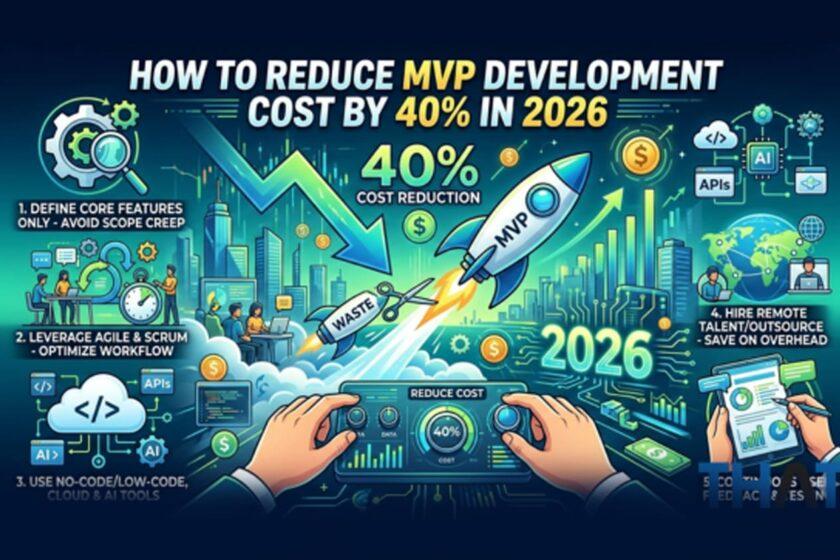
How to Reduce MVP Development Cost by 40% in 2026

Divya Krishnamurthy
Mar 15, 2026 · 11 min read
Key Architectural Takeaways
- Hierarchical chunking prevents context fragmentation.
- Semantic re-ranking (via Cohere) filters out noise and lowers token counts.
- Hallucination guardrails block invalid prompts before LLM invocation.
- Continuous prompt tracing detects vector database drifts.
The Mirage of the Notebook Demo
It takes about 15 lines of Python code to set up a working vector search and LLM response pipeline. However, once you deploy that to thousands of users searching through real business PDFs, user satisfaction tanks. Queries get irrelevant context, hallucinations skyrocket, and LLM token costs spiralled out of control.
Interactive RAG Pipeline Explorer
Click through the different components of a production-grade RAG architecture below to review the code implementation, primary failure modes, and best-practice solutions.
Smart Chunking
Instead of raw character splits which sever sentences, we parse documents into sections, sub-headings, and tables. Small sentences are indexed but mapped to their larger parent context.
Character-limit splits causing search tokens to fetch fragmented sentences.
Parent-Child relation index stores child vectors but returns parent nodes to LLM.
# Use LlamaIndex HierarchicalNodeParser
from llama_index.core.node_parser import HierarchicalNodeParser

node_parser = HierarchicalNodeParser.from_defaults(
    chunk_sizes=[2048, 512, 128]
)
nodes = node_parser.get_nodes_from_documents(documents)
Step 1: Implementing Hierarchical Chunking
Standard chunking cuts text at arbitrary character limits (e.g. 500 characters). This splits crucial sentences or structures in half. We moved to a Hierarchical Node parser: we split documents into larger sections, parse sub-points, and link them. The vector database searches the small chunks but feeds the larger parent context to the LLM.
Performing Hybrid Search & Re-ranking in Python
To filter out noise, we combine vector search (semantic) with BM25 (keyword search), and pass the top results through Cohere's re-ranking engine. This guarantees only high-relevance paragraphs are passed to GPT-4:
from cohere import Client
import numpy as np

co = Client("your-api-key")

def search_and_rerank(query, vector_db, top_k=20, final_top_n=3):
    # 1. Fetch semantic and keyword candidates
    semantic_results = vector_db.vector_query(query, limit=top_k)
    keyword_results = vector_db.keyword_query(query, limit=top_k)

    # Merge unique documents
    candidates = list({doc.id: doc for doc in (semantic_results + keyword_results)}.values())
    texts = [doc.text for doc in candidates]

    # 2. Re-rank utilizing Cohere Rerank
    rerank_response = co.rerank(
        model="rerank-english-v3.0",
        query=query,
        documents=texts,
        top_n=final_top_n
    )

    # 3. Compile high-relevance context
    final_docs = []
    for hit in rerank_response.results:
        final_docs.append(candidates[hit.index])
    return final_docs
Step 2: Guardrails and Evals
We deployed NeMo Guardrails to sanitize user input. If a user asks for recipes inside a corporate database portal, the guardrail rejects the request immediately. This alone decreased unnecessary LLM costs by 28% and eliminated brand safety risks.
Article Details
Divya Krishnamurthy
Mar 15, 2026
11 min read
Mobile App Development
Focus Technologies
Related Articles
 Mobile App Development
Building a Mobile Banking App: Security First Architecture

 Mobile App Development
Kubernetes Cost Optimisation: 7 Things Most Teams Miss

 Mobile App Development
The Hidden Cost of Technical Debt (and How to Quantify It)
